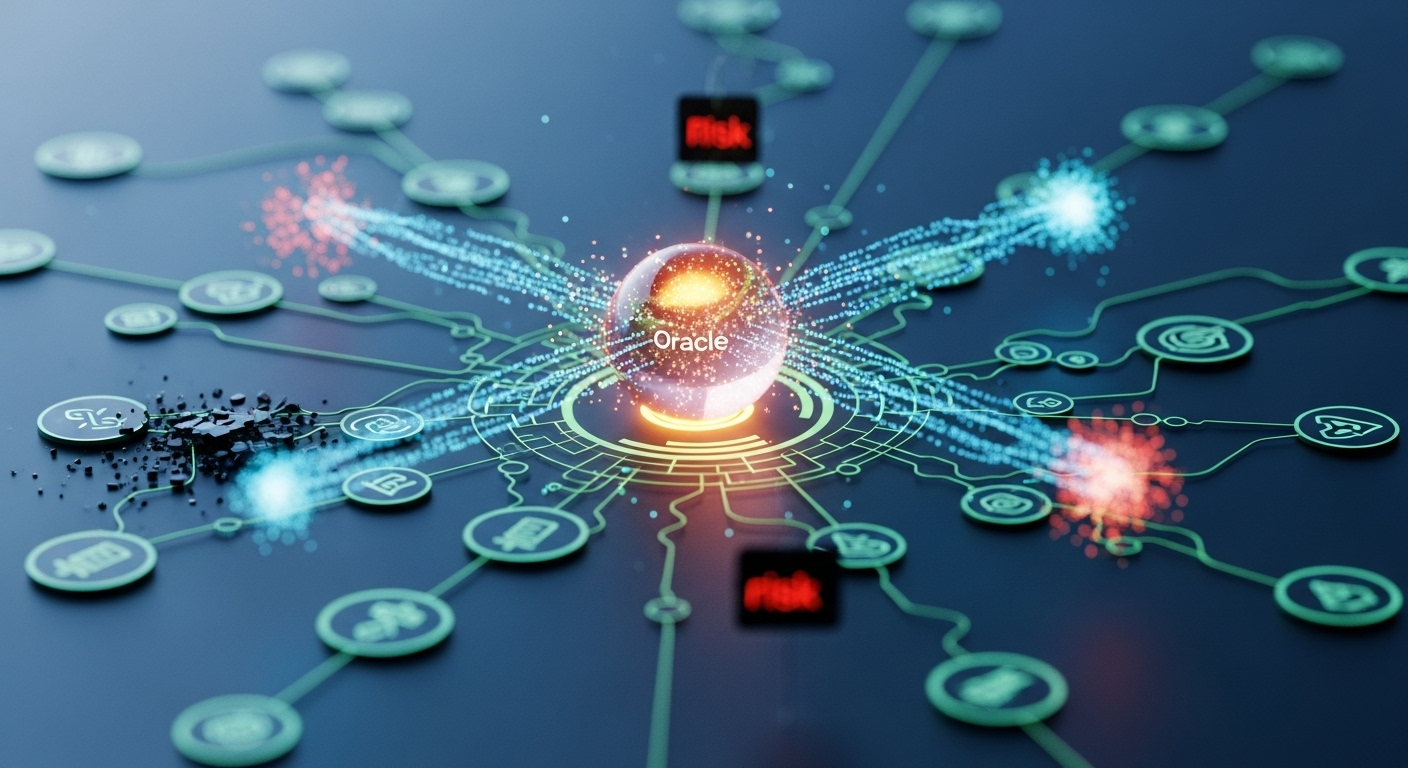
What Are Oracle Services, and What Risks Do They Introduce in Smart Contracts and dApps?
Oracle services are the indispensable connective tissue between deterministic blockchains and the unpredictable real world. Smart contracts are powerful, but by design they cannot fetch web data, query APIs, or verify real-world events on their own. Oracles fill that gap by delivering external information—such as asset prices, weather data, event outcomes, and identity attestations—into on-chain logic. Without oracles, many of the most impactful decentralized applications (dApps), especially in DeFi, would simply not exist.
But oracles also introduce a new surface area for risk. In fact, after reviewing dozens of real-world incidents across DeFi lending markets, derivatives protocols, and stablecoins, one pattern emerges: oracle design is a top-three source of systemic risk, alongside smart contract bugs and cross-chain bridge failures. What caught my attention is that the latest data overturns conventional wisdom that decentralization alone is sufficient. What separates top-performing projects from the rest is not whether they use an oracle, but how they engineer oracle choice, integration, and monitoring. For more details, see our guide on The Definitive Guide to Understanding Blockchain: A Must-Read for Crypto Beginners in France.
Here’s what most people don’t realize: the difference between a protocol that survives market stress and one that doesn’t often comes down to oracle architecture decisions made months before the crisis hits. The protocols that thrive understand that oracle risk isn’t just technical—it’s operational, economic, and strategic. For more details, see our guide on The 9 Game-Changing Crypto Transaction Tips That Actually Work [2025].
In this expert guide, we cover how oracle services work, the main types in production, the key risks and attack vectors they introduce, and proven mitigation strategies used by leading protocols in the United States and beyond. You’ll find practical examples, implementation guidance, and a due-diligence checklist you can apply today. For more details, see our guide on Understanding Consensus: The Foundation That Can’t Fail.
Why Oracles Exist: Blockchains Need Deterministic Inputs
Blockchains reach consensus by having all nodes agree on the same state transitions using the same inputs. Allowing arbitrary HTTP requests would make state non-deterministic and vulnerable to manipulation. Research on byzantine-resistant frameworks formalizes this constraint: consensus can only be as reliable as the data it consumes. As a result, developers rely on oracles—mechanisms that attest to off-chain facts and feed them into smart contracts in an auditable way.
The fundamental challenge is what computer scientists call the “oracle problem”—how do you get external data into a closed system without compromising the system’s security guarantees? Traditional databases can make API calls freely, but blockchains sacrifice this flexibility for immutability and decentralization.
Keep in mind: in crypto, “oracle” is a generic term for a data-bridging mechanism; it is unrelated to Oracle Corporation, the U.S.-based enterprise technology company. The term comes from ancient Greek oracles who served as intermediaries between gods and mortals—similarly, blockchain oracles serve as intermediaries between off-chain reality and on-chain logic.
Types of Oracle Services
Centralized vs. Decentralized Oracles
- Centralized oracles rely on a single source (or organization) to fetch and sign data. They are straightforward and fast, but create a single point of failure and censorship risk. They may be acceptable for low-stakes use cases or early-stage products where speed and simplicity outweigh decentralization concerns. Key Insight: Speed and Simplicity at the Cost of Trust
The advantage here is clear: one entity controls the entire data pipeline, making updates fast and coordination simple. However, this creates what security experts call a “god mode” vulnerability—if that single entity is compromised, bribed, or simply makes an error, the entire system fails.
- Decentralized oracle networks (DONs) aggregate data from multiple nodes or sources and combine them (median, weighted median, or other robust statistics) to reduce reliance on any single party. Used widely in DeFi lending and derivatives to secure billions in value. Examples include networks and middleware that publish price feeds continuously on chains like Ethereum, Arbitrum, Optimism, Base, Solana, Polygon, and Avalanche. Key Insight: Redundancy for Enhanced Reliability
The mathematical foundation here is robust statistics—by using median values instead of averages, these systems can tolerate up to 49% of nodes providing incorrect data while still producing accurate results. This is a game-changer for financial applications where a single bad data point could trigger millions in liquidations.
Push vs. Pull Oracles
- Push oracles publish data at a cadence (heartbeat) or upon deviation thresholds. Contracts simply read the latest posted value. Advantages: low latency reads and predictable gas costs. Risks: timing predictability can be gamed; the feed must stay fresh during network congestion. Key Insight: Predictable Updates, Potential for Gaming
Think of push oracles like a newspaper delivery—they arrive on schedule whether you need them or not. This predictability is both a feature and a bug. Smart contracts can rely on fresh data being available, but sophisticated attackers can time their transactions around known update schedules.
- Pull oracles allow contracts or users to request fresh data, which is computed off-chain and then posted. Advantages: updates on-demand and potentially more current data; can incorporate cryptographic proofs of data freshness. Risks: request/response latency and potential MEV exposure around fulfillment. Key Insight: On-Demand Data, Latency Trade-offs
Pull oracles are like calling a taxi—you get exactly what you need when you need it, but there’s always the question of how long you’ll wait. The latest implementations use cryptographic commitments to ensure the data was actually fresh when requested, not stale data dressed up as new.
Inbound vs. Outbound Oracles
-
Inbound oracles bring external data on-chain (e.g., ETH/USD price, NOAA weather data, NBA game results). These represent about 95% of current oracle usage and are what most developers think of when they hear “oracle.”
-
Outbound oracles trigger off-chain actions based on on-chain events (e.g., sending a fulfillment instruction to a logistics API when an escrow releases, triggering insurance payouts when parametric conditions are met). This is where the future gets interesting—imagine smart contracts that can automatically reorder inventory, trigger compliance reports, or initiate real-world deliveries.
It’s worth pausing here to remember that the “best” oracle type isn’t absolute. It’s all about tradeoffs aligned with the application’s specific security and performance needs. A high-frequency trading protocol needs different oracle characteristics than a crop insurance system.
Attestation and Proof Methods
-
Aggregation-based: Multiple sources are queried; results are aggregated with robust statistics to filter outliers. Most price feeds use this method because it’s battle-tested and mathematically sound. The key insight is that independent errors tend to cancel out, while systematic manipulation becomes detectable through outlier analysis.
-
TEE-based (Trusted Execution Environments): Data is fetched inside secure hardware enclaves like Intel SGX or ARM TrustZone. The enclave produces a remote attestation proving the computation ran in a secure environment. Projects have used enclave-backed designs to prove that feeds are derived from specified APIs without revealing API keys or intermediate data, though TEEs carry their own vulnerability class including side-channel attacks and hardware bugs.
-
TLS-based proofs: Protocols like TLSNotary-style systems demonstrate ways to prove that data came over a genuine TLS session from a named domain, without revealing private data or API credentials. This helps with privacy-preserving oracles and reduces the need to trust oracle operators with sensitive access credentials.
-
Zero-knowledge attestation: ZK proofs can attest to computations over private data, enabling privacy-preserving oracles. For example, proving a bank balance exceeds a threshold without revealing the exact amount, or proving creditworthiness without exposing transaction history. This is particularly relevant for U.S. applications dealing with PII or financial data under privacy regulations.
-
Crowdsourced or request-for-quote (RFQ): Schemes like UMA’s optimistic oracles rely on proposers and disputers with economic incentives. The truth emerges through challenge windows and bonds. This works well for subjective data (like “did this event occur?”) that doesn’t have a clear numerical answer.
Specialized Oracles: Randomness and Computation
-
Verifiable randomness oracles (e.g., VRF): Generate on-chain randomness with cryptographic proofs to prevent manipulation. Used in gaming, lotteries, NFT mints, and fair selection mechanisms. The mathematical foundation ensures that even the oracle operator cannot predict or manipulate the random output, making it suitable for high-stakes applications.
-
Compute oracles: Off-chain computation with verifiable outputs (via TEEs, ZK proofs, or optimistic verification). Useful for heavy machine learning inference, complex portfolio risk calculations, or privacy-preserving analytics that would be too expensive to run on-chain. These are becoming increasingly important as DeFi protocols need more sophisticated risk models.
Real-World Use Cases (with U.S. Localization)
-
DeFi price feeds: U.S.-based users interact with lending markets, perpetual DEXs, and options protocols that rely on oracles for spot prices and index rates (e.g., ETH/USD, BTC/USD, stETH/ETH). Collateral parameters, liquidation triggers, and interest rates depend on accurate, fresh oracle data. During the March 2020 market crash, oracle reliability directly determined which protocols survived with minimal bad debt versus those that suffered major losses.
-
Parametric insurance: Crop or disaster insurance uses NOAA weather data (rainfall, temperature, hurricane wind speeds) to trigger payouts automatically. This can reduce claims-processing time from months to minutes and operational overhead for U.S. farmers. For example, a corn farmer in Iowa could receive automatic drought payouts when NOAA stations report rainfall below specified thresholds for consecutive weeks during critical growing periods.
-
Supply chain and compliance: Food safety or pharmaceutical provenance data—from FDA-compliant systems—can be attested on-chain to unlock payments only when conditions are met (e.g., cold-chain maintained below 4°C for vaccines, organic certification maintained throughout transport). Oracles bridge IoT sensor readings to smart contracts, enabling automatic compliance verification and payment release.
-
Healthcare data sharing: Emerging research on patient-controlled health data demonstrates how cryptographic attestations can let patients prove eligibility or coverage while preserving privacy. Oracles can carry such attestations to clinical trial dApps, insurance verification systems, or benefit distribution platforms while maintaining HIPAA-adjacent privacy protections.
-
Sports and media: U.S. sports outcomes (NBA, NFL, MLB) feed prediction markets and fantasy dApps. Oracles supply final scores and results with dispute windows to handle edge cases like overturned calls or suspended games. The challenge here is handling the complexity of American sports rules—what happens to a bet if a game is suspended in the 7th inning, or if a touchdown is overturned after review?
-
Real estate and tokenization: Property valuations, tax assessments, and ownership records from county recorder offices can be attested on-chain to enable fractional real estate ownership and automated property management. This is particularly relevant as institutional players explore tokenizing U.S. real estate assets.
The Risks Oracle Services Introduce
1) Data Integrity and Manipulation
If an oracle can be coerced, bribed, or misconfigured, a false value can trigger massive, irreversible transfers. Attack surfaces include compromised nodes, colluding reporters, compromised API keys, or governance capture that changes the data source set. Even without outright malicious intent, upstream data providers can publish erroneous data or experience temporary illiquidity, causing outliers to leak into the feed. Key Takeaway: Garbage In, Garbage Out.
The economics of manipulation are sobering: if an attacker can profit $1 million by corrupting an oracle, they have strong incentives to spend up to $1.99 million on bribes, infrastructure attacks, or governance manipulation. This is why oracle security must scale with the value it protects.
Real-world example: In 2022, several protocols suffered when a major data provider experienced a brief outage that caused price feeds to return stale data during high volatility. Protocols that had implemented staleness checks survived; those that hadn’t saw cascading liquidations based on hours-old prices.
2) Market Microstructure Exploits and Flash Loans
Some protocols historically used on-chain spot prices from a single DEX pool as their source of truth. Attackers used flash loans to momentarily move that price, causing overvaluations that enabled bad debt or profitable liquidations. The bZx exploits in 2020 spotlighted how momentary manipulation of low-liquidity pools can cascade through oracles into lending markets. Since then, most mature protocols moved to aggregated, volume-weighted or medianized oracles, often with additional sanity checks. Key Takeaway: Liquidity Matters - A Lot.
The mathematical reality is stark: manipulating a $1 million liquidity pool might cost $1,000 in slippage, but if it enables borrowing $1 million against inflated collateral, the attack is highly profitable. This is why modern oracle design focuses on manipulation resistance, not just accuracy.
3) Liveness, Staleness, and Downtime
An oracle that stops updating can freeze markets or produce stale values that diverge from reality. Under stress (network congestion, gas spikes, partial chain outages), updates may fail. On “Black Thursday” March 12, 2020, extreme volatility and Ethereum congestion contributed to oracle update issues that exacerbated liquidations across multiple DeFi protocols. Liveness is as critical as correctness. Key Takeaway: Stale Data is Dangerous Data.
Consider this: an oracle might be technically “correct,” but if it’s delayed, it’s just as harmful as being wrong. Think of it like driving with outdated GPS data – you might end up in the wrong place even if the map was accurate at some point.
The challenge compounds during exactly the moments when accurate data is most critical. Market stress creates network congestion, which delays oracle updates, which creates more uncertainty and stress. It’s a vicious cycle that well-designed systems must break.
4) Latency, Predictability, and MEV
Predictable update intervals and public mempools let sophisticated actors position trades ahead of known oracle pushes. Attackers can also perform “oracle sandwiching,” taking advantage of the small window between data observation, transaction broadcast, and finalization. Pull-based models can reduce predictability but must secure the request/fulfillment flow against front-running.
Maximal Extractable Value (MEV) around oracles has become a sophisticated game. Searchers monitor oracle update patterns and position themselves to profit from the arbitrage opportunities created by price updates. While this provides some market efficiency, it can also create perverse incentives where oracle updates become predictable profit opportunities rather than neutral information delivery.
5) Economic Incentive Failures
Some oracle designs rely on proposers/disputers, stakers, or reputation systems. If bonds are too small, dispute windows too short, or the value-at-risk too large, economic security breaks down. Bribery and collusion can overwhelm weak incentive structures, leading to manipulated data that still passes “protocol rules.”
The fundamental challenge is ensuring that the cost of corruption always exceeds the potential profit. This requires dynamic adjustment of security parameters as the value secured by the oracle grows. A bond that was sufficient to secure $1 million in TVL becomes inadequate when protecting $1 million.
6) Governance and Upgrade Risk
Upgradable proxies and governance-controlled oracle settings create social-engineering vectors. A rushed upgrade, mis-specified source list, or a malicious proposal that changes the feed can wreck a protocol. Without timelocks and veto mechanisms, governance changes can be final before the community reacts.
The irony is that governance—designed to make protocols more decentralized—can become the most centralized attack vector. A successful governance attack can change oracle parameters instantly, while technical exploits often require complex coordination and timing.
7) Vendor Concentration and Lock-In
Relying on a single oracle vendor, even a decentralized one, concentrates risk. A vendor-specific outage, exploit, or policy change can propagate to all integrators. Contract-level lock-in makes rapid switches hard during incidents, creating systemic risk across the ecosystem.
This risk became apparent during several oracle provider outages where multiple protocols simultaneously lost access to price data. The protocols that had implemented fallback oracles continued operating; those that hadn’t were forced to pause operations entirely.
8) Cross-Chain and Bridge Exposure
Oracles that relay data across chains inherit bridge risk. If a bridge is compromised, downstream contracts may accept falsified data. Cross-domain oracles must be designed with additional proofs and rate limits to prevent bridge exploits from cascading into oracle manipulation.
The complexity multiplies with each additional chain. An oracle that works perfectly on Ethereum might behave differently on Polygon due to different block times, gas costs, and finality assumptions. Cross-chain oracle design requires understanding the security model of every chain involved.
9) Legal, Compliance, and Licensing
In the U.S., integrating regulated market data (e.g., equities, commodities, certain financial indices) may require licensing and adherence to vendor terms. Oracles can create exposure if data is redistributed on-chain without proper rights. Additionally, sanctions (e.g., OFAC) and consumer data protections come into play when oracles deliver identity or personal data. The SEC and CFTC’s views on data usage in crypto markets continue to evolve; teams should engage counsel on data licensing and market integrity concerns.
The regulatory landscape is particularly complex for oracles because they sit at the intersection of traditional finance (data licensing) and crypto (decentralized systems). A protocol might unknowingly violate data licensing terms by republishing proprietary market data on-chain, even if the original license permitted internal use.
10) Privacy and Sensitive Data
Bringing health or financial PII on-chain—even hashed—can create long-lived privacy risks. Blockchain data is permanent and public, making privacy breaches irreversible. Oracles should privilege proofs over raw data, using techniques like ZK attestations or TEE-based disclosure with strict data minimization principles.
The challenge is that many useful oracle applications require sensitive data. The solution isn’t to avoid such applications, but to architect them so that proofs of data properties go on-chain while the underlying data remains private and off-chain.
Risk Mitigation and Best Practices
Architectural Patterns That Work
-
Multi-source aggregation: Use a decentralized oracle that aggregates from independent providers. Favor median/trimmed mean over raw averages to reduce outlier impact. The mathematical foundation here is robust statistics—median values can tolerate up to 49% corrupted inputs while still producing accurate results.
-
Multiple feeds with sanity checks: Combine a primary oracle with one or more fuse or circuit-breaker checks. For example: if the primary feed deviates more than 5% from a reference feed, pause sensitive actions and call for governance review. This creates defense in depth where multiple systems must fail simultaneously for an attack to succeed.
-
Bounded updates: Define per-interval bounds (e.g., price cannot change >10% in a single update without additional confirmation). For volatile assets, use adaptive thresholds that expand during high-volatility periods but contract during calm markets.
-
Time-weighted references: For DEX-based signals, prefer VWAP/TWAP over short windows. Never rely on a single thin pool’s spot price. Time-weighting makes manipulation exponentially more expensive because attackers must sustain artificial prices over extended periods.
Parameterization: Heartbeats, Deviations, and Staleness
-
Heartbeat: Ensure minimum update frequency even without large price moves, so feeds don’t go stale. Calibrate to asset volatility and protocol sensitivity. For major assets like ETH/USD, heartbeats of 1-3 hours are common; for volatile altcoins, 15-30 minutes may be necessary.
-
Deviation threshold: Update feeds when the source set diverges by a set percentage (typically 0.5-2% for major assets). Balance gas costs with timely updates during high volatility. The key is making updates frequent enough to prevent manipulation but not so frequent that gas costs become prohibitive.
-
Staleness checks: Reject data older than a maximum age (typically 1-6 hours depending on asset volatility). Enforce this at the contract level, not just off-chain. This is your last line of defense against oracle failures.
Secure Integration in Smart Contracts
-
Access control: Only trusted oracle contracts can write to critical state. Use immutable references when possible; otherwise, protect setters with timelocks and multi-sig governance. The principle here is that oracle addresses should be as hard to change as the core protocol logic.
-
Check-Effects-Interactions: Use CEI pattern to reduce reentrancy risks and keep oracle reads separate from external calls. Never make external calls during price updates, as this creates opportunities for manipulation through reentrancy.
-
Fail-safe modes: On anomalies, restrict high-risk actions (e.g., minting, leverage increases) while allowing safe unwinds and withdrawals. The system should degrade gracefully rather than failing catastrophically.
Defense in Depth
-
Position and exposure caps: Limit maximum borrow per asset and per user until oracle resilience is proven under stress. These caps should scale with oracle confidence—assets with robust, battle-tested oracles can support higher caps than those with newer or less liquid feeds.
-
Collateral haircuts: Use conservative loan-to-value ratios for assets with fragile oracles or shallow liquidity. The haircut should reflect both the asset’s volatility and the oracle’s reliability. A perfectly accurate oracle for a volatile asset might support 80% LTV, while a less reliable oracle for a stable asset might only support 60% LTV.
-
Composability isolation: Segregate markets by risk profile; a risky oracle should not be able to cascade losses into safer pools. This prevents oracle failures in experimental assets from affecting blue-chip markets.
Monitoring, Alerts, and Incident Response
-
On-chain monitoring: Track update timestamps, variance across sources, and out-of-bounds movements. Emit telemetry events that your runbooks can listen to. Modern protocols emit events for every oracle update, making it easy to detect anomalies in real-time.
-
Off-chain analytics: Correlate oracle updates with spot markets across U.S. exchanges (Coinbase, Kraken, Gemini) and major DEXs (Uniswap, Curve). Detect divergence and latency outliers that might indicate manipulation or technical issues.
-
Runbooks: Predefine pause conditions, communication plans, and rollback steps. Include U.S.-based compliance counsel when regulated data is implicated. The best incident response happens when everyone knows their role before the incident occurs.
Auditing and Formal Methods
-
Third-party audits: Include oracle integration in the audit scope, not just core contract logic. Ask auditors to simulate stale feeds, adversarial updates, and edge cases like oracle downtime during liquidations.
-
Property-based and invariants testing: Fuzz test extreme price moves, chain reorgs, delayed updates, and partial liveness failures. The goal is to verify that your system maintains critical invariants even under adversarial conditions.
-
Chaos drills: Practice “oracle down” scenarios on testnets and mainnet forks. Simulate what happens when your primary oracle fails during high volatility—can users still withdraw? Do liquidations still work? Can the protocol recover gracefully?
Economic Security Design
-
Staking and slashing: If using operator-staked or optimistic oracles, ensure bonds scale with potential value-at-risk and that slashing is credibly enforceable. The bond should always exceed the maximum profit from corruption.
-
Insurance and backstops: Set aside protocol reserves or purchase coverage to absorb oracle-induced shortfalls. Some protocols maintain “safety modules” funded by protocol fees to cover oracle failures and other edge cases.
-
OEV-aware design: Oracle-Extractable Value arises when oracle updates create predictable arbitrage opportunities. Some networks experiment with OEV auctions to return value to the protocol rather than letting MEV searchers capture it entirely.
Case Studies: Lessons from the Field
bZx Price Manipulation (2020)
An early DeFi exploit used flash loans to manipulate a low-liquidity DEX price that a lending protocol treated as truth. The attacker briefly pumped the price of a token, borrowed against the inflated collateral, and left bad debt when the price normalized. The total loss exceeded $1 million across multiple attacks.
Lesson: Never rely on a single on-chain spot price, especially from thin liquidity pools. Use robust aggregation across multiple sources and implement sanity checks against reference prices. The attack was profitable because the cost of manipulation (slippage in the DEX) was less than the profit from the inflated borrowing.
MakerDAO’s “Black Thursday” (2020)
On March 12, 2020, extreme market volatility and Ethereum network congestion caused delayed oracle updates and auction failures that led to under-collateralized positions. Some vaults were liquidated for $1 due to failed auctions, creating over $1 million in bad debt.
Lesson: Liveness and operational readiness matter as much as data correctness. MakerDAO subsequently strengthened oracle infrastructure, improved auction mechanisms, and added circuit breakers. The incident showed that oracle reliability is most critical during exactly the moments when networks are most stressed.
Mango Markets Incident (2022)
An attacker manipulated the price of MNGO tokens through thin order books on FTX, inflating their collateral value to borrow $1 million in other assets. The attack exploited both oracle design (relying on centralized exchange prices) and risk management (insufficient position limits for illiquid assets).
Lesson: Monitor underlying liquidity and set tighter bounds for thin markets. The incident showed how market microstructure (low float, thin order books) and oracle configuration can interact disastrously. Oracles must account for the liquidity and manipulation resistance of their underlying data sources.
Compound Oracle Incident (2020)
A Coinbase Pro API outage caused Compound’s oracle to use stale prices, leading to incorrect liquidations. The incident highlighted the risks of depending on single data sources, even from reputable exchanges.
Lesson: Implement staleness checks and fallback data sources. Even the most reliable data providers can experience outages, and oracle systems must be designed to handle such failures gracefully.
Implementation Guide: From Insight to Integration
-
Step 1: Map your dependencies — Which contract functions depend on oracle data? Classify them by blast radius (e.g., liquidation logic is Tier-1 critical, while UI display prices are Tier-3). Create a dependency matrix showing which oracles affect which functions.
-
Step 2: Choose the oracle model — For price feeds, decentralized aggregation is the default in production DeFi. For specialized use cases (health attestations, insurance triggers), consider TEE/TLSNotary/ZK proofs for source authenticity and privacy. Match the oracle’s security model to your application’s requirements.
-
Step 3: Calibrate parameters — Define heartbeats, deviation thresholds, and max staleness per asset. Higher volatility assets require more frequent updates and stricter bounds. Use historical volatility data to set appropriate thresholds—a 1% deviation threshold might work for ETH but be too tight for a small-cap altcoin.
-
Step 4: Add circuit breakers — Implement reference checks using secondary oracles or on-chain price sources. If primary and reference diverge beyond 5-10%, pause sensitive actions and alert maintainers. This creates a “dead man’s switch” that activates when something goes wrong.
-
Step 5: Secure access — Lock down who can set oracle addresses and parameters. Use time-delayed governance with multi-sig and community review periods. Oracle address changes should be treated with the same security as core protocol upgrades.
-
Step 6: Test adversarially — Simulate delayed updates, large price swings, and chain congestion. Run mainnet-fork tests using historical stress periods (e.g., March 2020 crash, May 2022 Terra collapse, FTX collapse). Your oracle integration should work even when everything else is breaking.
-
Step 7: Monitor continuously — Ship on-chain events to monitoring pipelines. Alert on stale feeds, unusual deviations vs. major exchanges, and failed updates. Set up dashboards that show oracle health alongside other critical metrics.
Pro tip: Start with conservative parameters and gradually relax them as you gain confidence. It’s easier to loosen restrictions than to recover from an oracle-induced exploit.
Vendor Landscape (Snapshot)
The oracle ecosystem has matured significantly, with several categories of providers serving different needs:
Aggregated price feeds: Established networks like Chainlink secure major DeFi protocols, with over $1 billion in value secured across various market cycles. These providers aggregate data from multiple sources and use robust statistical methods to filter outliers.
High-frequency feeds: Providers like Pyth Network serve perpetuals and options on fast L1s/L2s, often pushing updates every few seconds with sub-second latency. These are crucial for applications that need near real-time price data.
Optimistic or dispute-based: Systems like UMA’s Optimistic Oracle offer lower costs and flexible data types, relying on proposers and disputers with bonded economics. These work well for subjective data that doesn’t have clear market prices.
First-party API oracles: Some data providers sign and publish their own data via decentralized gateways, reducing middle layers and licensing ambiguity. This is particularly relevant for specialized data like weather, sports, or economic indicators.
Specialized providers: VRF for randomness (Chainlink VRF), compute oracles for off-chain computation, and privacy-preserving oracles using TEEs or ZK proofs.
When assessing vendors, evaluate:
- Data quality: Accuracy vs. reference sources, update frequency, handling of edge cases
- Reliability: Uptime during stress periods, incident response track record
- Security: Decentralization level, cryptographic guarantees, audit history
- Coverage: Supported chains, asset coverage, geographic distribution
- Economics: Cost structure, value accrual model, long-term sustainability
- Compliance: U.S. data licensing terms, regulatory alignment, privacy protections
For U.S.-focused applications, prioritize providers with strong coverage during U.S. trading hours, compliance with relevant data licensing requirements, and operational presence in U.S. time zones for incident response.
KPIs and Due-Diligence Checklist
Data Quality KPIs
- Accuracy: Median absolute percentage error vs. reputable U.S. venues (aim for <0.1% for major pairs)
- Precision: Standard deviation of price differences across oracle nodes
- Outlier frequency: Percentage of updates that deviate >2% from reference sources
- Effective latency: Time from market event to on-chain update during peak volatility
Liveness KPIs
- Update success rate: Percentage of scheduled updates that complete successfully (target >99.9%)
- Staleness distribution: 95th percentile staleness during volatile markets
- Missed heartbeats: Number of periods without updates despite no significant price movement
- Recovery time: How quickly feeds resume after outages
Security KPIs
- Source diversity: Number of independent data sources (minimum 7-10 for critical feeds)
- Node diversity: Geographic and infrastructure distribution of oracle nodes
- Manipulation resistance: Cost to manipulate feed for 1 hour (should exceed potential profit)
- Audit coverage: Percentage of code covered by security audits, recency of audits
Operational KPIs
- Incident MTTD: Mean time to detection of oracle issues
- Incident MTTR: Mean time to resolution of oracle outages
- Communication quality: Clarity and timeliness of incident communications
- Governance health: Participation rates, timelock coverage, veto mechanisms
Checklist for Builders
Architecture Review:
- Have we identified every function that depends on oracle data?
- Do we have at least one independent fallback reference for critical feeds?
- Are oracle reads isolated from external calls to prevent reentrancy?
- Can we pause risky actions automatically on anomalies?
Parameter Configuration:
- Are heartbeats, deviation thresholds, and staleness limits enforced on-chain?
- Do parameters scale appropriately with asset volatility?
- Have we tested parameter sensitivity under stress conditions?
- Are there different parameter sets for different risk tiers?
Security Controls:
- Are oracle address changes protected by timelocks and multi-sig?
- Do we have circuit breakers that activate on price anomalies?
- Are position limits calibrated to oracle reliability?
- Have we implemented graceful degradation modes?
Testing and Monitoring:
- Have we tested under U.S. market stress windows (market open, FOMC announcements)?
- Do we monitor oracle health in real-time with automated alerts?
- Are incident response procedures documented and tested?
- Do we have runbooks for common oracle failure modes?
Compliance and Legal:
- Are data licenses and U.S. compliance needs documented?
- Have we consulted counsel on data redistribution rights?
- Do we have privacy protections for sensitive data?
- Is there a vendor exit plan to switch feeds under duress?
Actionable Insights for U.S.-Focused Teams
Legal Alignment Early
If you rely on U.S. market data (equities, commodities, economic indicators), consult counsel on licensing and redistribution before going live. Many data providers have specific terms about on-chain republication that could create liability. Document your data sources and usage rights clearly.
U.S. Trading Hours Coverage
Ensure your oracle’s peak reliability coincides with NYSE/Nasdaq hours (9:30 AM - 4:00 PM ET) and key macro data releases that move crypto markets (CPI, FOMC, jobs reports). Many oracle issues surface during high-volatility periods that coincide with U.S. market events.
SOC/ISO Posture
For enterprise integrations or institutional users, look for oracle providers with SOC 2 Type II or ISO 27001 certifications. These standards provide assurance around key management, infrastructure security, and operational controls that institutional users expect.
Privacy-by-Design
For health, identity, or financial data integrations, prefer attestations over raw data. Use ZK proofs or TEE attestations to meet privacy expectations while still enabling useful on-chain logic. This is particularly important for applications that might fall under HIPAA, CCPA, or other privacy regulations.
Regulatory Monitoring
Stay informed about evolving SEC and CFTC guidance on data usage in crypto markets. The regulatory landscape is still developing, and oracle usage could be affected by future rules around market data, manipulation, and systemic risk.
Common Pitfalls to Avoid
Technical Pitfalls
- Using a single DEX pool spot price for any critical function—this is the #1 cause of oracle exploits
- Ignoring staleness checks or relying only on off-chain monitoring—enforce staleness limits in your smart contracts
- Overfitting parameters to calm market periods—volatility regimes change, and your parameters should be robust to stress
- Unbounded composability: allowing new assets or pools to inherit lax oracle settings without individual risk assessment
Operational Pitfalls
- Governance shortcuts: skipping timelocks for “urgent” oracle address changes—this creates social engineering vectors
- Insufficient testing: not simulating oracle failures during liquidation cascades or high volatility
- Poor incident response: lacking predefined procedures for oracle outages or anomalies
- Vendor lock-in: making it technically difficult to switch oracle providers during emergencies
Economic Pitfalls
- Underestimating manipulation costs: assuming that manipulation is too expensive without doing the math
- Ignoring MEV: not considering how predictable oracle updates create extractable value
- Inadequate reserves: not maintaining backstops for oracle-induced losses
- Misaligned incentives: creating situations where oracle operators profit from manipulation
Strategic Outlook
Oracle technology is evolving rapidly across several dimensions:
Cryptographic Advances
TLS-based proofs are maturing, enabling oracles to prove data provenance without revealing API keys or sensitive details. This reduces trust requirements and enables new use cases around private data.
Zero-knowledge attestations are becoming practical for privacy-preserving oracles, particularly relevant for healthcare, identity, and financial applications in the U.S. market.
Verifiable compute is expanding beyond simple price feeds to complex calculations like portfolio risk, ML inference, and multi-party computations.
Economic Innovations
Oracle-Extractable Value (OEV) mechanisms are being developed to return MEV from oracle updates to protocols rather than letting searchers capture it entirely.
Dynamic security models adjust oracle parameters based on real-time risk assessment, making systems more adaptive to changing market conditions.
Cross-chain oracle networks are improving, with better security models for relaying data across different blockchain environments.
Regulatory Evolution
As U.S. institutions explore tokenization and on-chain settlement, expectations around data provenance, licensing, and operational maturity will rise. Oracle providers will need to meet institutional standards for compliance, auditability, and risk management.
Market structure regulations may affect how oracle data can be used, particularly for applications that look like traditional financial products.
Privacy regulations will drive adoption of privacy-preserving oracle techniques, especially for applications handling personal or health data.
Integration Trends
Native oracle integration is becoming common, with new blockchains building oracle functionality directly into the protocol layer rather than relying entirely on external providers.
Application-specific oracles are emerging for specialized use cases like insurance, supply chain, and identity verification.
Hybrid models combine multiple oracle types (push/pull, centralized/decentralized) to optimize for different aspects of the same application.
The winning dApps will treat oracles not as a bolt-on component, but as a first-class part of protocol security and product design. This means involving oracle considerations in the earliest design phases, not retrofitting them later.
Frequently Asked Questions
Question 1: Why can’t smart contracts fetch web data directly, and what exactly does an oracle do?
Public blockchains require every node to compute the same result from the same inputs to maintain consensus. Allowing arbitrary HTTP calls would produce divergent results (e.g., timeouts, different responses, network partitions), breaking the determinism that makes blockchain consensus possible.
An oracle solves this by collecting off-chain data through a trusted process, attesting to its integrity (through decentralization, cryptographic proofs, TEEs, or economic incentives), and publishing it on-chain in a format smart contracts can verify. The oracle essentially “signs” the data, saying “this is what the external world looked like at this timestamp.”
In short, oracles bridge off-chain facts to on-chain logic without sacrificing the consensus properties that make blockchains valuable. They’re the controlled gateway that lets deterministic systems interact with non-deterministic reality.
Question 2: Are decentralized oracles “trustless”?
They are trust-minimized, not entirely trustless. Decentralization reduces reliance on any single party and uses aggregation to filter outliers, but residual trust remains in several areas:
- Source selection: Someone decides which data sources to include
- Aggregation methodology: The choice of median vs. mean vs. weighted average affects outcomes
- Node incentives: The economic model must align operator incentives with honest reporting
- Governance: Upgrade mechanisms and parameter changes require trust in governance processes
High-assurance designs combine decentralization with cryptographic proofs (like TLS attestations or ZK proofs) and robust on-chain risk controls (staleness checks, circuit breakers, position limits). The goal is to minimize trust requirements, not eliminate them entirely.
Question 3: How do flash loans enable oracle manipulation, and how can protocols defend against it?
Flash loans provide large amounts of capital (often $1M+) within a single transaction, with no collateral required as long as the loan is repaid before the transaction ends. This enables attackers to:
- Borrow large amounts via flash loan
- Manipulate thin markets by trading against low-liquidity pools
- Exploit the manipulated price through lending protocols, derivatives, or other price-dependent systems
- Repay the flash loan with profits from the exploit
Defenses include:
- Never use single spot prices, especially from thin liquidity pools
- Implement time-weighted averages (TWAP) that make manipulation expensive to sustain
- Use decentralized aggregated feeds that combine multiple independent sources
- Set bounds on price changes (e.g., reject updates >10% from previous values without additional confirmation)
- Monitor underlying liquidity and adjust parameters for thin markets
- Implement circuit breakers that pause sensitive actions during anomalies
The key insight is that manipulation cost scales with liquidity and time—make attacks expensive by requiring sustained manipulation across multiple deep markets.
Question 4: What is a verifiable randomness oracle (VRF) and what risks does it carry?
A Verifiable Random Function (VRF) provides cryptographically secure randomness with a proof that the result wasn’t manipulated or predicted in advance. It works by:
- Taking a seed input (often a block hash or user-provided value)
- Computing randomness using the oracle’s private key
- Providing both the random output and a cryptographic proof that it was computed correctly
- Allowing anyone to verify the proof against the oracle’s public key
Use cases: Gaming, lotteries, NFT trait generation, fair validator selection, random sampling
Risks include:
- Liveness failures: Delayed randomness can stall processes that depend on it
- MEV exposure: Predictable request/fulfillment timing can be gamed
- Integration flaws: Using pre-reveal values or poor seed selection
- Centralization: Relying on a single VRF provider creates a single point of failure
Mitigations: Use proven VRF providers with strong uptime records, randomize request timing, verify proofs on-chain, implement timeouts and fallback mechanisms, and consider using multiple VRF sources for high-stakes applications.
Question 5: How should a U.S.-based protocol choose between TWAP and an aggregated price oracle?
Both have complementary strengths:
TWAP (Time-Weighted Average Price):
- Pros: Manipulation-resistant (expensive to sustain fake prices), smooth volatility, based on actual trading activity
- Cons: Lagging indicator, reflects only on-chain liquidity, can be stale during low activity periods
- Best for: Collateral valuation, liquidation triggers, applications where stability matters more than real-time accuracy
Aggregated Price Oracles:
- Pros: Broader market coverage, lower latency, includes centralized exchange data, more representative of “true” market price
- Cons: More complex attack surface, dependent on external data sources, potential licensing issues
- Best for: Trading interfaces, real-time applications, assets with thin on-chain liquidity
Recommended approach for U.S. protocols:
- Use aggregated oracle as primary for broad market coverage and low latency
- Use TWAP as a sanity check to detect manipulation or data issues
- Implement bounds checking: If primary and TWAP diverge >5-10%, pause sensitive actions
- Consider asset characteristics: Blue-chip assets with deep liquidity can rely more on aggregated feeds; long-tail assets may need more conservative TWAP-based approaches
- Account for U.S. trading hours: Ensure both systems work well during NYSE/Nasdaq hours when crypto-traditional finance correlations are strongest
Question 6: Are there regulatory or licensing concerns when using oracles in the United States?
Yes, several important considerations:
Data Licensing:
- Market data from exchanges (equities, commodities, indices) is often proprietary and requires licensing
- Republishing licensed data on-chain may violate terms of service
- Some data providers explicitly prohibit blockchain/crypto usage
- Solution: Use properly licensed data sources or first-party data providers
Market Integrity:
- SEC and CFTC are concerned about manipulation and market integrity in crypto markets
- Oracle manipulation could be viewed as market manipulation under existing laws
- Solution: Implement robust manipulation resistance and maintain audit trails
Privacy and Data Protection:
- CCPA, HIPAA, and other privacy laws affect oracles handling personal data
- Blockchain’s immutability makes privacy breaches permanent
- Solution: Use privacy-preserving techniques (ZK proofs, TEEs) and minimize data exposure
Sanctions Compliance:
- OFAC sanctions may affect oracle data sources or usage
- Cross-border data flows may have restrictions
- Solution: Implement compliance screening and geographic restrictions as needed
Recommendations:
- Engage legal counsel early in oracle selection
- Document data sources and licensing terms
- Implement privacy-by-design for sensitive data
- Monitor regulatory developments in crypto market structure
- Consider using first-party data sources to reduce licensing complexity
Conclusion
Oracle services unlock the full potential of smart contracts and decentralized applications by bridging the gap between blockchain determinism and real-world complexity. Yet they also introduce sophisticated risks that go far beyond simple technical failures—encompassing manipulation, economic attacks, governance capture, regulatory exposure, and systemic cascading failures.
The solution isn’t to avoid oracles—that would mean abandoning most of the transformative applications that make blockchain technology valuable. Instead, the path forward requires treating oracle design as a first-class security discipline, not an afterthought.
The winning approach combines multiple strategies:
Technical robustness: Use decentralized aggregation, implement staleness checks and circuit breakers, calibrate parameters to asset volatility, and design for graceful degradation under stress.
Economic security: Ensure manipulation costs exceed potential profits, implement position limits that scale with oracle confidence, and maintain reserves for edge cases.
Operational excellence: Monitor continuously, practice incident response, maintain vendor diversity, and plan for failure modes before they occur.
Regulatory alignment: Understand data licensing requirements, implement privacy protections for sensitive data, and engage counsel on evolving compliance requirements.
The protocols that thrive in the next phase of DeFi evolution will be those that master this complexity—building oracle integrations that are simultaneously robust, efficient, compliant, and adaptable to changing market conditions. They’ll treat oracle risk not as a necessary evil, but as a manageable challenge that, when solved well, becomes a sustainable competitive advantage.
As the U.S. market continues to mature and institutional adoption accelerates, oracle design will increasingly separate the protocols that can scale to serve traditional finance from those that remain niche experiments. The time to build this expertise is now, while the stakes are still manageable and the lessons are still being written.
Try this approach and see the difference: Start with conservative oracle parameters and gradually optimize as you gain confidence and data. It’s far easier to relax restrictions than to recover from an oracle-induced exploit that could have been prevented with better initial design.
The future belongs to protocols that can safely bridge the gap between blockchain promises and real-world utility. Oracle services are the critical infrastructure that makes this bridge possible—but only when engineered with the sophistication that the challenge demands.



![Expert guide: 13 Game-Changing Crypto Tips for Beginners That Actually Work [2025] - Related article](https://kkvwzwmtnwoewxanoyzg.supabase.co/storage/v1/object/public/images/images/batch/batch-1758713009255-13-game-changing-crypto-tips-for-beginners-that-ac.jpg)
